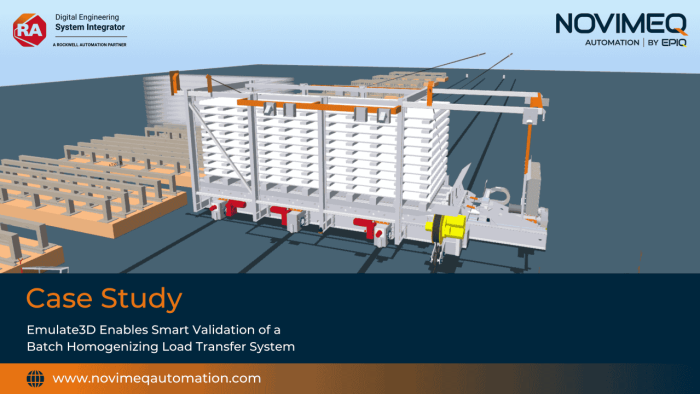
Case Study – Emulate3D Enables Smart Validation of a Batch Homogenizing Load Transfer System
In large-scale metal processing plants, even a small design oversight can lead to significant operational disruptions. Equipment often interacts with multiple systems, operates under strict safety constraints, and must perform reliably in demanding environments. When upgrades or design changes are introduced, validating performance early becomes critical, not just to protect equipment, but to safeguard people, productivity, and long-term operational efficiency.
A leading global aluminium producer faced exactly this situation when planning an upgrade to their Batch Homogenizing Load Transfer Car. Before committing to physical manufacturing, the customer wanted complete confidence that the new design would function correctly across all operating scenarios. This requirement led to a digitally driven validation approach using Rockwell Automation’s Emulate3D, delivered by NOVIMEQ Automation.
The Need for Early Validation in Complex Material Handling Systems
The Batch Homogenizing Load Transfer Car plays a crucial role in the aluminium homogenizing process. It is responsible for transferring heavy loads between multiple stations, including furnaces, coolers, and loading tables. Each movement must be precise, coordinated, and safe, as the system operates in close proximity to equipment and personnel.
Any design flaw discovered after fabrication could result in:
- Costly mechanical rework
- Extended commissioning timelines
- Unplanned downtime during startup
- Increased safety risks
To avoid these outcomes, the customer decided to validate the complete system behaviour digitally before building hardware.
Project Objective
The primary objective was to digitally validate the new transfer car design under real operating conditions. This included verifying motion behaviour, control logic, safety interlocks, and interactions with surrounding equipment. The customer wanted to ensure that all manual and automated operations worked reliably and safely, with no surprises during commissioning.
Challenges
Several technical and operational challenges needed to be addressed:
- The existing transfer car had known operational limitations, prompting the need to test a redesigned system virtually before fabrication.
- Manual motions such as translation, extension/retraction, and lifting had to be verified for accuracy, repeatability, and safety.
- Safety conditions including interlocks, photocells, reflectors, and alignment checks needed to be tested under all possible operating scenarios.
- The transfer car interacted with multiple stations, making collision detection and sequence validation critical.
- The customer wanted to eliminate the risk of discovering design issues after manufacturing, where changes would be expensive and time-consuming.
Digital Engineering Approach
To address these challenges, NOVIMEQ adopted a digital engineering and virtual commissioning approach using Rockwell Automation’s Emulate3D platform. The focus was to create a realistic digital representation of the system that behaved exactly like the real equipment would on the shop floor.
Before moving into detailed simulation, NOVIMEQ worked closely with the customer to understand the operating philosophy, safety requirements, and expected motion sequences. This ensured that the virtual model would accurately reflect real-world usage rather than idealized assumptions.
Solution: Virtual Commissioning with Emulate3D
NOVIMEQ developed a complete virtual commissioning model for the Batch Homogenizing Load Transfer Car using Emulate3D. The solution included:
- A detailed 3D simulation replicating all mechanical motions, including translation, extension/retraction, and lifting operations.
- Accurate modelling of safety components such as interlocks, photocells, reflectors, and alignment conditions.
- Integration of real PLC logic and HMI with the virtual model to test actual control sequences.
- Simulation of full movement paths between furnaces, coolers, and loading tables to identify and prevent potential collision scenarios.
- Validation of motion timings, stop behaviour, safety logic responses, and operator-dependent actions in a safe virtual environment.
By connecting the digital model directly to the control logic, the customer could observe how the system would behave during real operations long before any hardware was built.
Results and Benefits
The virtual commissioning approach delivered clear and measurable value:
- Design issues were identified and resolved early, before physical fabrication began.
- All manual motions and safety conditions were verified to work reliably and safely.
- PLC logic, interlocks, and assisted positioning were tested without risking equipment or operator safety.
- Collision risks and alignment issues were eliminated upfront, preventing costly rework.
- Commissioning time was significantly reduced, as PLC and HMI logic had already been tested virtually.
- The customer gained high confidence in system performance before deploying the solution on the actual equipment.
Tools Used
- Rockwell Automation Emulate3D
- Studio 5000
- FactoryTalk Logix Echo
- FactoryTalk View Studio
Conclusion
This project demonstrates how digital engineering and virtual commissioning can fundamentally change the way complex industrial systems are designed and validated. By shifting validation earlier in the project lifecycle, NOVIMEQ helped the customer reduce risk, improve safety, and achieve smoother commissioning outcomes.
For systems that involve multiple interactions, strict safety requirements, and high operational impact, virtual commissioning using Emulate3D provides a practical and proven path to better project execution.
Get in Touch with NOVIMEQ Automation
If you are planning to validate complex automation systems, reduce commissioning risks, or adopt digital engineering practices such as simulation and virtual commissioning, NOVIMEQ Automation can support you at every stage of the project lifecycle. Connect with our team to explore how early digital validation can improve safety, reliability, and project outcomes.
Phone: +91 8956 402 701 | +91 8983 267 998
Email: [email protected]