Case Study: Virtual Commissioning and Testing of a New Production Line with Emulate3D
Imagine a newly installed production line starting for the very first time. Cans begin moving rapidly across conveyors. Everything appears smooth until it isn’t.
At the check-weigh station, a sensor fails to detect a can. Instead of following the correct path, it gets misrouted. Within seconds, more can follow the same incorrect path, and can start accumulating.
In another section, a slight conveyor misalignment causes unstable movement. Combined with an excessive slope, can begin to wobble and eventually fall off the conveyor. Further down the line, at a U-bend section, the rail width is just slightly narrower than required. Flow becomes restricted. Pressure builds up. A sudden jam occurs.
Now the entire line stops.
Operators rush in to clear the blockage. Spilled cans scatter across the floor, creating slippery conditions. The system is restarted, only for the issue to repeat. What started as a minor design oversight quickly turns into: Unplanned downtime, Product loss and material waste, Increased operator risk and Delays in production startup and most importantly, rising costs.
This is exactly where Virtual Commissioning plays a critical role, helping to identify and resolve such issues before the system goes live.
The Background
When one of the world’s largest food and beverage manufacturers set up a new production line, everything looked perfect on paper.
The system was designed for high-speed operation, where multiple conveyors, sensors, and processing stations needed to work in perfect synchronization. In such environments, even the smallest gap in design, whether it’s a missing sensor, slight misalignment, or incorrect dimension, can disrupt the entire system.
In high-speed beverage production, problems don’t stay small for long. They escalate quickly, impacting productivity, safety, and overall efficiency. Understanding these risks, the customer wanted to ensure that their system would perform as expected right from the first day of commissioning.
The Challenge
The production line involved continuous movement of cans across multiple conveyor sections, including check-weigh stations, transfer points, and curved paths. While the design was technically complete, several critical issues were not immediately visible during conventional design reviews.
During the initial assessment, the following risks were identified:
- Missing sensors, leading to unreliable detection and inconsistent machine response
- Check-weigh station sensors are failing to detect cans accurately, causing incorrect routing
- Conveyor misalignment, indicating potential operational instability
- Excessive conveyor slope increases the risk of product fall-off
- Insufficient rail width at U-bend sections, restricting smooth product flow
If these issues were discovered during physical commissioning, they could have resulted in significant downtime, repeated manual intervention, and costly redesign efforts. More importantly, commissioning time would increase, directly impacting project timelines and cost.
NOVIMEQ’s Approach
Instead of waiting for these challenges to surface during commissioning, NOVIMEQ adopted a proactive approach through Virtual Commissioning and testing of the new production line using Emulate3D.
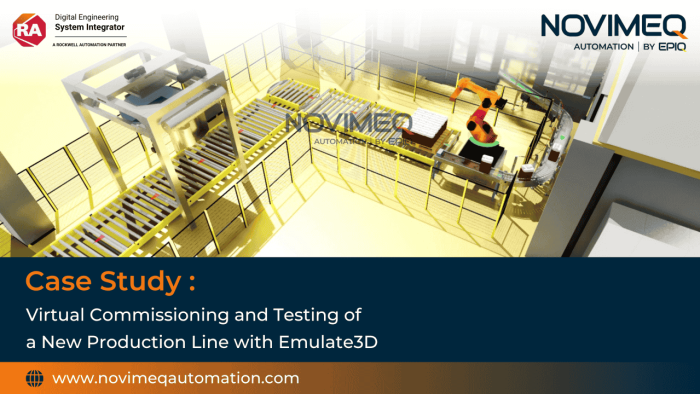
The entire production line was recreated in a virtual environment.
This was not just a visual model; it was a working digital replica of the system. Every conveyor movement, sensor interaction, and process flow was simulated to behave exactly like the real system.
In addition to mechanical validation, the actual PLC logic was also tested in the virtual environment before commissioning . This ensured that both system behavior and control logic were aligned and working as expected.
By integrating real system logic and simulating real operating conditions, the team was able to test the system in a completely risk-free environment, well before physical deployment.
What We Did
Once the digital model was ready, NOVIMEQ conducted a detailed evaluation of the system.
The simulation allowed the team to observe how products moved across the line, how sensors responded, and how different sections interacted with each other under real operating conditions.
Through this process:
- The entire conveyor system was simulated to validate real-time performance
- Missing sensing points were identified, and additional sensors were recommended to ensure accurate detection
- Mechanical misalignment became clearly visible, allowing early correction
- The conveyor slope was analyzed and optimized to prevent product instability and fall-off
- Rail clearance at U-bend sections was evaluated, and design improvements were suggested to enable smooth flow
- PLC logic and control sequences were tested virtually to ensure correct system response
What made this approach powerful was the ability to test multiple scenarios, something that is difficult, time-consuming, and risky in a real environment.
The Impact
By validating the system before installation, NOVIMEQ helped the customer avoid multiple operational and design-related issues.
The results were clear:
- Improved line stability through early detection of design and mechanical issues
- Reliable product detection with optimized sensor placement
- Elimination of potential jams and flow restrictions
- Reduced risk of product loss and unplanned downtime
- Minimal need for onsite modifications during commissioning
- Faster and more confident system startup
- Reduced commissioning time due to prior virtual validation
Instead of reacting to problems during commissioning, the customer entered the startup phase with a system that had already been tested and verified. Most importantly, the overall project risk was significantly reduced before actual implementation, enabling smoother execution and better planning.
Conclusion
While high-speed manufacturing industries like food and beverage need precision, even minor design gaps can result in major operational issues.
What looks like a minor design gap can lead to downtime, safety concerns, and financial losses when the system goes live.
This case clearly demonstrates how Virtual Commissioning and testing of a new production line can shift the approach, from reacting to problems to preventing them entirely.
By testing both system behavior and PLC logic in a virtual environment, manufacturers gain the ability to:
- Visualize real-world behavior before installation
- Detect hidden issues early
- Validate control logic before commissioning
- Reduce commissioning time and effort
- Minimize overall project risk prior to implementation
For NOVIMEQ, it’s not just about simulation. It’s about delivering systems that work right the first time. Whether you’re planning a new setup or optimizing an existing system, validating your processes before implementation helps reduce risk and ensures on-time commissioning.
Email: [email protected]
See it before it happens. Fix it before it costs.
Innovate. Deliver. Empower. all with Passion for Challenges
All images are copyrighted by NOVIMEQ Automation.
© NOVIMEQ Automation. All rights reserved.