Case Study: Virtual Commissioning of Billet Handling System using Emulate3D
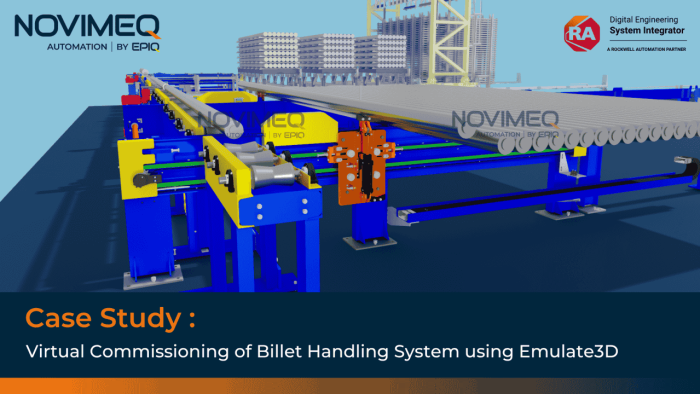
A new aluminum processing facility is preparing for startup.
Massive tickets move through multiple stages, from casting pit collection and billet cutting to layer forming, load building, and packaging. Cranes coordinate with transfer systems, safety interlocks monitor every movement, and operators rely on precise machine behavior to keep operations running smoothly.
But in a greenfield project, one important question always remains.
What happens if a design issue is discovered only after the equipment is manufactured and installed?
A single collision risk, mistimed sequence, or unsafe motion condition can lead to costly rework, delayed commissioning, major safety concerns, and ultimately production downtime. To eliminate these risks before physical deployment, a virtual commissioning approach was adopted using Rockwell Automation’s Emulate3D, implemented by NOVIMEQ Automation.
Background
The project involved validation of a complete billet handling system used in the aluminum homogenizing process. The system was responsible for handling tickets laid down by operators from the casting pit with cast data input into the system, billet cutting, layer forming, load building using the HOMO crane, load dismantling, and arranging tickets on conveyor systems for strapping operations.
Any design flaw discovered after fabrication could result in:
- Costly mechanical rework
- Extended commissioning timelines
- Unplanned downtime during startup
- Increased safety risks
Since the system involved multiple equipment interactions and safety-critical movements, the customer wanted complete confidence that all operations would function correctly before physical manufacturing and installation.
The Need for Early Validation in Complex Material Handling Systems
To avoid these outcomes, the customer decided to validate the complete system behavior digitally before building hardware.
Challenges
Several technical and operational challenges needed to be addressed:
- Manual motions such as translational, Layer Forming, Load Building and lifting had to be verified for accuracy, repeatability, and safety.
- Safety conditions including interlocks, photocells, reflectors, and alignment checks, needed to be tested under all possible operating scenarios.
- The Billet Handling System interacts with the Working HOMO Transfer Car, making collision detection and sequence validation critical.
- The customer wanted to eliminate the risk of discovering design issues after manufacturing, where changes would be expensive and time-consuming.
Solution
To address these challenges, NOVIMEQ adopted a digital engineering and virtual commissioning approach using Rockwell Automation’s Emulate3D platform. The focus was to create a realistic digital representation of the system that behaved exactly like the real equipment would on the shop floor.
Before moving into detailed simulation, NOVIMEQ worked closely with the customer to understand the operating philosophy, safety requirements, and expected motion sequences. This ensured that the virtual model would accurately reflect real-world usage rather than idealized assumptions.
The solution included:
- A detailed 3D simulation replicating all mechanical motions, including translational and lifting operations.
- Accurate modeling of safety components such as interlocks, photocells, reflectors, and alignment conditions.
- Integration of real PLC logic and HMI with the virtual model to test actual control sequences.
- Simulation of full movement paths between the Laydown Table at the Pit Stripping area, Billet cutting, Layer Forming, Load Building, Load Dismantling and Conveyor System for billet arrangement for strapping operations and prevent potential collision scenarios.
- Validation of motion timings, stop behavior, safety logic responses, and operator-dependent actions in a safe virtual environment.
By connecting the digital model directly with the control logic, the customer was able to observe actual system behavior and validate operations before physical commissioning.
Results
The virtual commissioning approach delivered clear and measurable value:
- Design issues were identified and resolved early, before physical fabrication began.
- All manual motions and safety conditions were verified to work reliably and safely.
- PLC logic, interlocks, and assisted positioning were tested without risking equipment or operator safety.
- Collision risks and alignment issues were eliminated upfront, preventing costly rework.
- Commissioning time was significantly reduced, as PLC and HMI logic had already been tested virtually.
- The customer gained high confidence in system performance before deploying the solution on the actual equipment.
Tools Used
- Rockwell Automation Emulate3D
- Studio 5000
- FactoryTalk Logix Echo
- FactoryTalk View Studio
Conclusion
In billet handling applications, multiple equipment interactions, coordinated crane movements, lifting operations, and safety-critical sequences must work together reliably from day one.
For greenfield projects, identifying a design or sequence issue after fabrication can lead to significant rework, commissioning delays, operational risks, and additional project costs.
This project demonstrates how Virtual Commissioning using Emulate3D helped validate the complete billet handling process before physical deployment. By testing motion behavior, PLC logic, safety interlocks, equipment interactions, and sequences transfer in a virtual environment, potential issues were identified and resolved early in the engineering phase itself.
Through this approach, the customer gained the ability to:
- Visualize complete billet handling operations before installation
- Validate lifting, translational, and load-building sequences safely
- Detect collision and alignment risks early
- Test PLC and HMI behavior under realistic operating conditions
- Reduce commissioning time and overall project risk
For NOVIMEQ Automation, virtual commissioning is not just about simulation, it is about helping manufacturers deploy safer, more reliable, and commissioning-ready systems with greater confidence before startup.
Get in Touch with NOVIMEQ Automation
See it before it happens. Fix it before it costs.
Innovate. Deliver. Empower. all with Passion for Challenges
All images are copyrighted by NOVIMEQ Automation.
© NOVIMEQ Automation. All rights reserved.